Boilers and water heaters, Junkers
EA error in Junkersboiler or heater: why it doesn't detect the flame (and what to check before replacing parts)
EA error Junkers has locked your boiler or water heater (either the pilot light is flashing or the red LED is on), leaving you without hot water. If you've done a little research, you've probably already read the typical response: "It's not detecting a flame, check the gas supply." That might be true, but it's only half the story. That phrase can mask up to six different faults, and half of them have nothing to do with a lack of gas.
This guide to the Junkers EA error explains what your appliance is actually measuring when it appears, how to identify the fault group in five minutes, what typically fails depending on the model family, and which part is usually responsible in each case. And, most importantly, when to stop and call a technician.
Quick summary
- In many cases, gas leaks are due to a lack of gas: a closed valve, a supply interruption, air in the pipe after changing the meter or cylinder, or cold butane. It's always best to start there.
- EA error mean Junkers? Typically, the hob opens the gas supply, attempts to ignite, and within the safety time (a few seconds), fails to receive a flame signal. For safety reasons, it shuts off the gas supply and locks out.
- First: see if you can even see a flame for a second. That splits the problem into two very different paths.
- If there is never a flame: it is usually due to the gas supply, the spark, or the gas valve.
- If the flame comes out and goes out: the problem is most likely in the detection circuit (ionization electrode, its cable, the grounding or moisture) and not in the gas.
- Do not rearm more than two or three times in a row. If EA appears again, there is most likely an underlying cause that needs to be identified.
What does your Junkers actually measure when it gives EA?
This is the point that almost no one explains, and it changes everything. Your boiler doesn't "see" the flame with an eye or a thermometer. It detects it by ionization: inside the burner, there's a metal rod (the ionization electrode) that's immersed in the flame. The heating element applies voltage to this rod, and since the flame conducts electricity very little, a tiny current (on the order of microamps) flows from the electrode, through the flame, to the burner's ground.
If that current appears, the hob interprets it as "there's a flame, I'll continue." If it doesn't appear within the expected time, the hob interprets it as "I've turned on the gas and it hasn't ignited," closes the valve, and displays EA. In water heaters like the miniMAXX, for example, that window is usually around 10 seconds.
Do you see the trick? For the control panel, it's the same whether there's no flame or there is a flame but it can't measure it. That's why so many people can clearly see the fire ignite through the viewing window, and yet the boiler still locks out with an EA error after a few seconds. It's not that the boiler is malfunctioning: it's that the flame is there, but the signal isn't getting through.
The five-minute diagnosis of the EA Junkerserror: does a flame ever appear?
Before touching anything, do this test. Reset it once, turn on hot water (open a tap) or heating, and look at the burner sight glass or the flame indicator on the panel, if your model has one.
Path A: You hear sparks, but no flame appears at any point
Here we're most likely dealing with gas or spark ignition. Check them in this order, from free to expensive:
- Gas shut-off valve on the appliance and main gas shut-off valve. It seems obvious, but in our experience it's one of the most common causes after construction work, an inspection, or a gas shut-off by the gas company.
- Are the stove burners working? If it's a gas stove and it still won't light, the problem is usually not your Junkers: it's the gas supply (meter, regulator, shut-off valve). Call your gas supplier.
- Air in the gas line. After changing the gas meter, replacing the gas cylinder, or carrying out work on the installation, the gas line can fill with air, causing the boiler to run out of time before the gas arrives. Sometimes two or three ignition attempts are enough. If not, purging the gas line is the installer's job.
- Butane or propane in cold weather. With cylinders outdoors or in a cold room, the gas loses pressure and the flame is weak or doesn't ignite. This is a common problem with heaters like the miniMAXX: if the cylinders freeze, move them to a warmer location. Also, check the regulator on the cylinder.
- Weak spark or spark in the wrong place. If the ignition electrode is dirty, bent, or the wire is cracked, the spark may jump to another location (against the casing, for example) and fail to ignite the gas. With the appliance off and the lights dimmed, you can sometimes see the spark jump where it shouldn't.
- A gas valve that won't open. This is the last suspicion, not the first. Diagnosing it requires measuring the voltage at the coil and the gas pressure at the inlet and outlet, and is the exclusive job of a certified installer.
Path B: the flame appears, lasts a few seconds and goes out with EA
This is the most confusing scenario, and the one where the most money is wasted replacing perfectly good parts. If there's a flame, it usually means the gas is flowing, and the problem is most likely with the detector. Check:
- Dirty ionization electrode. With use, it becomes covered with a whitish or oxide layer that insulates the rod. The ionization current drops so low that the circuit board no longer recognizes it. This is probably the most common cause in older devices.
- Electrode misaligned. If the rod has shifted and is no longer properly positioned in the flame, the signal may be weak or intermittent. An electrode cannot be bent arbitrarily; it has a specific position relative to the burner.
- Electrode cable. Check for cracks or cuts. A cable cracked by heat can short the signal to ground before it reaches the plate.
- Grounding. This is the "trick" that almost never appears in forums. The ionization signal returns to the circuit board through the appliance's ground connection. If your home's electrical system has a poor ground connection, or the outlet doesn't have one, the detection may fail even if everything else is perfect. With Celsius heaters, this is usually one of the first checks: Is 220V present? Is there a good ground connection? In some models, even the reversed wires (live and neutral) in the outlet can affect the reading.
- Humidity in the electronics. Condensation, a water leak dripping onto the junction box, or a device installed in a very humid location. In the Eur(Heatronic junction box) and several other models, this is a common point of failure.
- Poor combustion. A weak, yellowish flame, or one that jumps away from the burner, is a sign of poor performance. This can be caused by inadequate flue gas evacuation, a blocked flue, or, in condensing boilers, an incorrect gas/air ratio. This requires a combustion analyzer: installer.
Beware of the EC code. The miniMAXX Excellence water heater has a specific code, EC, for "intermittent ionization failure." If your Junkers alternates with EC, it usually indicates that the problem lies with the electrode signal rather than the gas.
Your Junkers doesn't display "EA"... but it may have the same fault
Many older or simpler models don't have a display, and the same fault manifests differently. If your boiler belongs to one of these families, this is what an EA error code typically represents:
- Eur(ZW…-1): Red LED lit along with the third green LED. A spark is usually present, but the control electrode does not detect a flame.
- Ceraline Acu (ZWSE 28-5 MFK/MFA): the indicator light flashes once repeatedly.
- Celsius heaters (WT…, WTD…): there are sparks but the burner does not ignite and the fault LED flashes (on the Celsius Plus it appears as EA).
- Ceraclass Midi (ZW 24 AE/KE): Displays "EA" with the reset symbol. The cause must be resolved, and the reset button must be pressed to restart the unit.
Junkers EA error according to your model: what usually goes wrong in each family
Based on our experience with these devices, this is what is usually checked for the EA code in each family, along with what it usually means in practice.
Condensing boilers: Cerapur, Cerapur Comfort, Cerapur Excellence and Cerapur Acu
In all four cases, EA usually indicates that no flame is detected. The standard procedure is to check the gas valve, the flow pressure at the gas outlet, the electrical supply, the electrodes and their cable, the exhaust gas pipe, and the gas/air ratio. For natural gas, the gas flow controller should also be checked.
One often overlooked detail: in condensation systems, there's a very common additional suspect: the condensate trap. If it becomes clogged, condensate can rise into the combustion chamber, causing the flame to smother or become unstable, and detection will fail. This same trap is usually checked when the FA code appears. It's inexpensive to inspect and should be ruled out before the gas valve.
Eur(ZC/ZWC …MFK/MFA)
Here, the EA (Emergency Argument) is usually due to a lack of ionization current. It's advisable to check the gas valve and pressure, the ignition electrode and its cable, the ionization electrode and its cable, the exhaust system, and the CO2 level.If your Euralso occasionally displays F7 (incorrect ionization signal), it usually points to the electrode and moisture in the junction box.
Ceraclass Excellence and Cerastar (ZSC/ZWC…3 MFA/MFK, ZWN 24-7 MFA)
EA usually means "no flame detected," and the checklist is the standard one: gas shut-off valve, gas inlet pressure, electrical connection, ignition electrode, and ionization electrode with its cables. In MFK (natural draft) versions, also check codes A2 to A6: if they alternate with EA, the underlying problem may be with flue gas evacuation.
Eurostar Acu-Hit (ZWSE 23-4 MFK, ZWC 28-4MFA)
This usually indicates an exceeded ignition time without a flame appearing, and the most likely cause is the ignition system (electrodes and cables), the ionization system, the valves, or the gas valve. If the F0 error code appears repeatedly, the main board may need replacing, but only if the problem persists after checking everything else.
Heaters: miniMAXX, miniMAXX Excellence, HydroPower-Plus and Celsius
The logic is the same for heaters, with some nuances:
- miniMAXX (WR-2): This is usually due to exceeding the 10-second ignition time, either because the burner is under-gas or because the electrode is not detecting the flame. The appliance will lock out. If you are using butane, check the regulator and the temperature of the gas cylinders.
- miniMAXX Excellence (WTD…KME): It's also advisable to purge the gas line and check the supply pressure. And remember: if it alternates with EC, it's most likely due to ionization.
- HydroPower-Plus (WTD…KG): the open gas valve, supply pressure, wall connection and ignition and ionization electrodes are usually checked.
- Celsius / Celsius Plus: This may be due to a lack of signal at the ionization electrode, air in the gas pipe, moisture or dirt on the electrode, or a lack of gas.
What you can do (and what you can't)
You can do this without risk:
- Check gas valves, that the gas stove is working, and the condition of the gas cylinders and their regulator.
- Check that the appliance's plug or electrical connection has an earth connection (an electrician can measure it in minutes).
- Check for water drips on the appliance or visible moisture inside without opening the chamber.
- Note the exact sequence: Is there a spark? Is there a flame? How many seconds does it last? Does it always happen or only sometimes? This information saves the technician time (and money).
You should not do this if you are not a certified installer:
- Open the combustion chamber, remove the burner or electrodes in sealed or condensing boilers. When reassembling, replace the gaskets and check for leaks.
- Adjust the gas valve, its setting, or the gas/air ratio.
- Manipulate the smoke evacuation.
How many times can I reassemble?
Once or twice to rule out a temporary fault (air in the line, a momentary power outage) is reasonable. Repeatedly resetting is not. Each failed attempt introduces unburned gas into the combustion chamber. The system is designed to handle this safely, but if the appliance locks up repeatedly, there's likely a problem.
Replacement parts that usually resolve an EA Junkers error
If a technician or your own diagnosis points to the electrode, these are the original kits we have for Junkers. Always check the exact model on your rating plate before purchasing


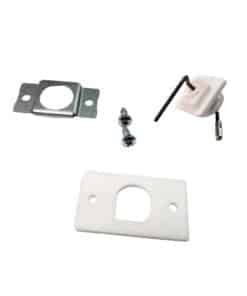
Don't see your model? Take a look at spare parts Junkers or write to us with the reference from the rating plate and we'll tell you which part is right for you.
Frequently Asked Questions
Does the EA Junkers error mean the motherboard is damaged?
Normally not. The circuit board is what reports the fault, but the cause is usually related to the gas supply, the spark, or the flame detection (electrode, cable, grounding, moisture). Replacing the circuit board is the last resort, after everything else has been checked.
I see the flame ignite and yet EA still comes out, why?
Because the boiler doesn't detect the flame visually, but rather by the current flowing through it. If the ionization electrode is dirty or misaligned, its cable is damaged, or the grounding is faulty, the flame will most likely be present, but the heating element won't "hear" it.
Why does the EA only come out in winter?
If you use butane or propane, the cold reduces the gas pressure in the cylinders. It can also be a factor that in winter the appliance runs longer and produces more condensation, which in condensing boilers can worsen a partially clogged trap.
Can I clean the ionization electrode myself?
For water heaters with easy access, a professional can usually do it in minutes. For sealed and condensing boilers, it involves opening the combustion chamber and replacing gaskets, so it must be done by a qualified installer.
What is the difference between EA, F7 and FA?
All three errors relate to the flame, but in reverse. EA usually indicates that the boiler was expecting a flame and isn't detecting one. F7 usually indicates that it's detecting a flame when there shouldn't be one (before turning on the gas or with the appliance turned off). FA usually indicates that it's still detecting a flame after turning off the gas. In F7 and FA cases, the most likely cause is moisture, the electrode, or the gas valve, and not a lack of gas.
Other Junkers error codes
If your appliance displays a different code, you have the guides for error E9 (overheating), NTC probes (A7, E2, E4, Ad, A9) and pressure switch (C6, C4, C1), or the error code table Junkers.
Important notice
This article is a guide based on our experience as a spare parts store. It is not a substitute for professional diagnosis. Every appliance and every installation is different, and the same error code can have different causes.
Any work on the gas circuit, combustion, or flue system must be carried out by a qualified installer, in accordance with the Technical Regulation for the Distribution and Use of Gaseous Fuels (RD 919/2006) and the Regulation on Thermal Installations in Buildings (RITE). Manipulating these elements without the necessary qualifications can be dangerous and will void the appliance's warranty.
The decision to purchase a replacement part based on this information is the sole responsibility of the customer. ElectroCholo is not liable for incorrect diagnoses or damage resulting from improper installation. Electrical and electronic parts that have been assembled or installed are non-returnable if the fault turns out to be something else, in accordance with our general terms and conditions.
