Boilers and water heaters, Junkers
Error A4, A3, A2 and A6 in Junkers: flue gas outlet and AGÜ probe
Your Junkers has shut off and is displaying A4 (or A3, A2, or A6). The A4 error Junkers is not usually a minor malfunction: it most likely means that the combustion fumes are not escaping through the chimney as they should and are instead flowing back into the kitchen. The sensor that monitors this, the so-called AGÜ sensor or flue gas sensor, has usually done its job: cutting off the gas supply before carbon monoxide reaches the house.
Therefore, the number one rule with this code is simple: don't reset it repeatedly to see if it starts. Ventilate it first, then find the cause. In this guide, we'll tell you what each code usually indicates, the most common cause we see in our experience (and that almost no one suspects), what to check depending on the model, and when it's necessary to replace the sensor.
Quick summary
- A4: usually indicates smoke outlet through the draft diverter (the gases return to the kitchen instead of going up the chimney).
- A3: The smoke probe is usually disconnected, cut, or short-circuited. This is typically a fault in the probe itself or its cable.
- A2 and A6: appear mainly in Ceraclass Excellence / Cerastar natural draft boilers: fumes in the combustion chamber (usually due to a dirty heat exchanger) and failure of the chamber sensor.
- Most common cause of A4: the extractor hood turned on in a closed kitchen, or the chimney is obstructed or has wind problems.
- What to do now: turn off the device, open windows and wait about 10 minutes for the probe to cool down before reassembling.
- If it happens again: don't try to fix it. Call a licensed gas fitter: there is a risk of carbon monoxide poisoning.
What does the smoke probe monitor (and why are only some Junkersequipped with it)?
Natural draft boilers and water heaters (those without a fan that vent through a conventional chimney) have a component at the top called a draft diverter . This opening balances the chimney's draft. If the chimney is working properly, the flue gases rise. If there is insufficient draft, the gases can overflow through the draft diverter into the room.
The flue gas sensor (in Junkers it's known as the draft control device or AGÜ sensor, from its German acronym). It's a small thermostat: when the hot gas overflows and heats it, it shuts off the appliance. That's why the A4 error code often appears on a Junkers. And that's why it's best to wait for it to cool down before allowing it to restart.
Sealed boilers (with a fan and flue gas outlet through a pipe to the facade, versions AE or MFA) typically don't use this sensor: their equivalent is the pressure switch, which usually displays codes C1, C4, or C6. If your boiler is sealed, you'll find what you're looking for in our guide to error codes C6, C4, and C1 Junkers .
JunkersA4 error: smoke is not coming out of the chimney
These are the causes we usually see, ordered from cheapest (and most frequent) to most expensive:
1. The kitchen extractor hood
This is one of the most common causes, yet the one that few people suspect. A powerful extractor fan in a kitchen with the door and windows closed creates negative pressure: it draws air from wherever it can, and the easiest way is usually to expel it through the water heater's chimney, in the opposite direction. The fumes don't rise, they overflow through the draft diverter, and the A4 fuse can trip.
The clue: the problem occurs when you're cooking with the extractor fan on, or right after replacing it with a more powerful one. Try using hot water with the extractor fan off and a window open. If it doesn't happen then, you've most likely found the cause.
2. Lack of air in the kitchen
A natural draft appliance needs air to burn the gas. Blocked kitchen ventilation grilles (whether with tape, a piece of furniture, or cardboard "to keep out the cold") or very airtight new windows can have the same effect as a range hood: the appliance can't breathe properly and the chimney won't draw well. If you recently replaced your windows and the A4 (presumably referring to a specific type of gas heater) started appearing this winter, suspect this.
3. Obstructed chimney or chimney with poor ventilation
Bird nests (very common in autumn, after a summer without heating), accumulated soot, a loose section of the chimney, or a damaged cap can all cause this. Windfactor: on stormy days, if the chimney outlet is poorly positioned, the wind can push the smoke downwards. If the A4 error code only appears on very windy days, the problem is most likely with the chimney outlet. This should be checked by a chimney installer or a chimney sweep.
4. Heat exchanger dirty with soot
If the burner has been malfunctioning for some time, soot can clog the fins of the heat exchanger (the coil through which the exhaust gases pass). The gases don't flow properly, accumulate in the combustion chamber, and overflow. This is often accompanied by a yellow flame and black stains on the top of the appliance. It requires thorough cleaning and combustion adjustment: a job for a professional installer.
5. The smoke probe, finally
Only when all the above has been ruled out does it make sense to suspect the sensor: it might have a loose connection, a frayed wire from the heat, or the thermostat itself might be out of adjustment and cutting off prematurely. It's an inexpensive part, but replacing it without first ruling out a leak is dangerous: if the sensor was tripping for a reason, the new one will probably trip the same way.
Error A3: probe or cable failure
Unlike A4, A3 doesn't usually indicate a smoke problem, but rather an electrical one: the circuit board doesn't "see" the sensor because the circuit is open or short-circuited. The usual scenario:
- A loose or corroded connector on the probe or circuit board. Unplugging, cleaning, and plugging it back in solves the problem more often than you might think.
- Burnt or frayed cable: it passes too close to the draft diverter and the heat dries it out over the years.
- Open probe: This is measured with a multimeter; it usually shows continuity when at rest. If it doesn't, the probe is most likely defective.
In the Ceraclass Midi, it usually appears as a faulty gas control device, and in the EurAcu-Hit, as a disconnected or shorted smoke sensor. The diagnosis is usually the same.
A2 and A6: especially in Ceraclass Excellence and Cerastar with natural draft
Ceraclass Excellence / Cerastar boilers in the natural draft version (ZSC/ZWC… 3 MFK) usually have a second probe in the combustion chamber. This results in two additional codes:
- A2: This usually indicates smoke in the combustion chamber. The typical cause is a dirty heat exchanger: the gases cannot pass through and remain inside.
- A6: usually points to a fault in the combustion chamber sensor (cut or shorted), the same as A3 but in the other probe.
If your Junkers doesn't have a screen
- Eurline (ZW…-1): A red LED illuminated with the second and fifth green LEDs usually indicates poor drainage. The usual troubleshooting steps involve checking the pressure switch (AE version), its connections, the fan, and the AGÜ sensor. This is explained in the fault light Eurline.
- Ceraline Acu (ZWSE 28-5): In the natural draft version (MFK), four flashes of the pilot light usually indicate smoke escaping through the draft diverter or the combustion chamber. More details on Ceraline Acu flashes.
Junkers A4 error and other codes: what they usually indicate depending on the model
In our experience, this is what each code typically means in the most common models. It is for guidance only: the same code can have different causes.
Euromaxx (ZC 28 and ZWC 24/28-1 MFK, natural draft)
A3: This usually indicates a broken or short-circuited flue gas probe in the draft diverter; the probe and its connections should be checked. A4: This is usually due to smoke escaping through the draft diverter; the flue section should be checked.
Eurostar Acu-Hit (ZWSE 23-4 MFK, KE versions)
A3: This usually indicates a disconnected or short-circuited smoke sensor. A4: This could be due to a smoke sensor failure. In both cases, the usual procedure is to check the evacuation system and the AGÜ probe. Note: In this model, F0 may also appear during the AGÜ probe connection test.
Ceraclass Midi (ZW 24 KE)
A4: This usually indicates that the gas control has been activated. The usual procedure is to check the chimney, its layout, and any obstructions, and wait for the probe to cool down before resetting. A3: This usually indicates a faulty gas control device; it is advisable to check the device and its wiring.
Ceraclass Excellence / Cerastar (ZSC/ZWC… 3 MFK)
A2 and A3: usually indicate smoke in the combustion chamber, typically due to a dirty heat exchanger; A3 can also be due to the smoke sensor itself. A4: usually indicates smoke from the draft diverter. A6: usually points to the combustion chamber sensor.
Heaters
- miniMAXX (WR-2): The A4 error code usually indicates an open backflow preventer (AGÜ). This locks out the heater. The usual solution is to ventilate the room and wait about 10 minutes.
- HydroPower-Plus (WTD…KG): A4 usually indicates that the exhaust gas control has been activated.
What you can do (and what you can't)
Yes you can:
- Turn off the appliance, ventilate the kitchen well and wait 10 minutes before resetting.
- Check if the fault occurs when the extractor hood is on or when the kitchen is closed.
- Uncover the ventilation grilles and do not cover them again.
- Check if it only comes out on windy days, and tell the technician: it saves him time.
- Install a carbon monoxide detector in your kitchen. It costs little and is one of the best investments you can make if you have a natural draft appliance.
You shouldn't:
- Reassemble repeatedly without ventilation.
- Bypassing the smoke probe "to see if it starts" is literally disabling the system that prevents carbon monoxide poisoning.
- Tampering with the chimney, draft diverter, or burner if you are not a qualified installer.
If the probe turns out to be the culprit, replacing it is usually simple for a technician, but it should be done after checking the draft with the appliance running.
Spare parts related to the Junkers A4 and A3 error
Smoke probes and draft control devices:

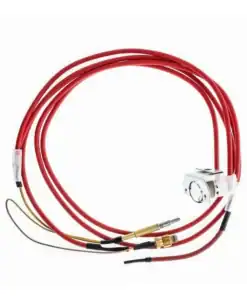


Can't find the part for your model? Check all spare parts Junkers or spare parts for water heaters. Always check the reference number of your old part before ordering.
Frequently Asked Questions
Is the JunkersA4 error dangerous?
It's possible. The appliance has switched off precisely to protect you, but this usually indicates that fumes escaped into the house at some point. If this happens again, don't use it until a technician has checked it and ventilate the room well. If you experience headaches, dizziness, or nausea while it's running, turn it off, go outside, and call emergency services (112).
I only get A4 paper when I'm cooking. Why?
The problem is most likely with the extractor fan: it creates negative pressure in the kitchen and can draw fumes downwards. Use the fan with a window slightly open or consult an installer about an air intake solution.
Why does it appear more in autumn?
Because that's when heating is used again after months of disuse: there can be bird nests, leaves, or soot in the chimney, and windows are closed more often. A check before the start of the season usually prevents most of these problems.
I've replaced the sensor and it's still showing A4. Is the part faulty?
The old probe was most likely fine, and the problem is with the venting. Check the range hood, ventilation, and chimney before considering other parts.
Where can I see the rest of my Junkerscodes?
In our error code index Junkers, organized by code and by model.
Important notice
This article is a guide based on our experience as a spare parts store. It is not a substitute for professional diagnosis. Every appliance and every installation is different, and the same error code can have different causes.
Any work on the gas circuit, combustion, or flue system must be carried out by a qualified installer, in accordance with the Technical Regulation for the Distribution and Use of Gaseous Fuels (RD 919/2006) and the Regulation on Thermal Installations in Buildings (RITE). Manipulating these elements without the necessary qualifications can be dangerous and will void the appliance's warranty.
The decision to purchase a replacement part based on this information is the sole responsibility of the customer. ElectroCholo is not liable for incorrect diagnoses or damage resulting from improper installation. Electrical and electronic parts that have been assembled or installed are non-returnable if the fault turns out to be something else, in accordance with our general terms and conditions.
