
Boilers and water heaters, Junkers
F7 and FA error in Junkers: detects flame with the appliance switched off (what it means and what to check)
The F7 error Junkers (or FA) locks your appliance, and what you see on the screen doesn't make much sense: "detects flame with the appliance off." How can there be a flame if it's not switched on? That's precisely the key. In our experience, in most cases there's no flame at all: the control board is mistaking something for a flame. This could be moisture, a dirty electrode shorting to ground, or a poor ground connection. However, there is one case, the FA error, where there could be a serious problem with the gas valve, and it's important to know how to distinguish between them.
Quick summary
- F7: The hob detects a flame when there shouldn't be one, before the gas is turned on or with the appliance switched off. This is most commonly due to moisture or a faulty electrode.
- FA: The hob continues to detect a flame after the gas is turned off. This could be due to moisture or the electrode, but also to a gas valve that is not closing properly.
- Note: On some models (Eurand Ceraclass Midi), F7 and FA may mean slightly different things. Check the section for your model.
- If you smell gas or the burner remains lit after turning it off: close the gas valve and call a certified technician. Do not reset it.
Why does the boiler "see" a flame that doesn't exist?
boilers and water heaters Junkers detect the flame by ionization: they apply a small voltage to an electrode inside the burner and measure the tiny current that passes through the flame to the ground. We explain this in detail in the guide for error code EA, which is the exact opposite problem.
The consequence is that any path that allows current to pass through resembles a flame. A drop of water connecting the electrode to the casing, moisture on the circuit board, a wire with damaged insulation touching ground, or an electrode covered in conductive dirt. The board cannot distinguish this from a real flame, so it shuts down for safety. Therefore, in our experience, moisture is the usual suspect in these two error codes.
JunkersF7 Error: What to Check
- Moisture on the hob or connections. Is the appliance in a damp place, on an enclosed terrace, or on the stovetop? Has there been any water leak or condensation? An F7 error code that appears mainly in the mornings or on humid days often points to this.
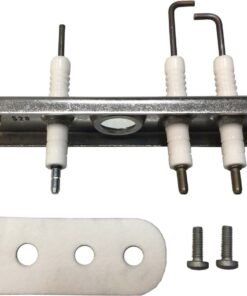
- Electrode and its cable. A dirty, cracked, or misaligned electrode, or a cable with cracked insulation, can divert current to ground.
- Flue. In several models, it's advisable to check that the flue is in good condition. A flue with condensation dripping inside can end up wetting the burner and electrodes.
- Grounding and power supply. In Celsius heaters, it's usual to start here: Is 220V present? Is there a good ground connection?
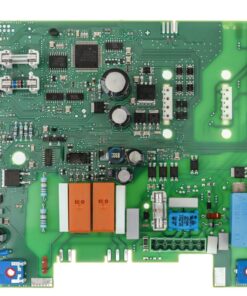
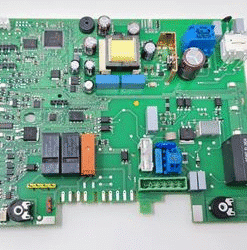
- The circuit board. If everything else is working correctly and the F7 error persists, the board may be damaged. It's the last thing to check, not the first.
FA: What to check (and when it's serious)
FA is the opposite of F7: the appliance has just shut off the gas, but the hob is still showing a flame. There are two very different possibilities:
- There's no real flame: just like with the F7, it's due to humidity, the electrode, or the wiring. That's the most common problem.
- Yes, there is a real flame: the gas valve may not be closing completely, and the burner is still receiving a trickle of gas. This is a safety hazard. If, when you turn off the appliance, you see through the viewing window that the flame doesn't go out, or you smell gas, turn off the gas valve and call a certified gas technician.
In condensing boilers, there's an extra suspect: the condensate trap should be cleaned. If the trap becomes clogged, condensate can flow back towards the burner and wet the electrodes.
Junkers F7 error depending on the model: what is usually checked
In our experience, the meaning and standard checks vary slightly depending on the appliance family. Here's what we typically see for each:
Condensing boilers: Cerapur, Comfort, Excellence and Acu
F7: This usually indicates that a flame is present even after the gas has been turned off. The usual steps are to check the electrodes, the gas line, and ensure the electronic board is not wet. FA: This usually indicates that a flame is still detected after the gas has been disconnected. It is advisable to check the gas valve, clean the condensate trap, and inspect the electrodes and the gas line.
Ceraclass Excellence and Cerastar
F7: Flame with the appliance switched off. Most likely, the electrodes and cable, the exhaust gas path, and moisture on the plate need to be checked. FA: Usually indicates that a flame is still detected after the gas is turned off. The ionization electrode and gas valve are usually checked.
Eur(note, different meaning)
F7: This usually indicates an incorrect ionization signal. Check the ionization electrode and its cable (for cracks or cuts) and check for moisture in the Heatronic junction box. FA: This may indicate that the ionization current is persisting after a normal shutdown. The usual procedure is to check the gas body wiring.
Ceraclass Midi (note, different meaning)
F7 with reset: This usually indicates an incorrect ionization signal: damaged ionization electrode and cable, or moisture. FA: This could be a gas valve error, so the usual procedure is to check the valve wiring.
Eurostar Acu-Hit (ZWSE 23-4 MFK, ZWC 28-4 MFA)
F7: The boiler detects a flame before the gas is turned on. It's usually a good idea to check the ionization, the main circuit board, and for any moisture on the board. FA: Ionization current is still present after closing a safety valve. The gas block safety valves most likely need to be checked, and moisture in the electronics should be ruled out.
Heaters
- miniMAXX: F7 usually indicates the presence of a flame after the hot water supply has been cut off, or a circuit board failure. It locks the appliance.
- miniMAXX Excellence: F7, check electrodes, cable and plate; FA, gas valve and gas duct.
- HydroPower-Plus: F7, check electrodes and cable, gas duct and plate; FA, call an authorized technician.
- Celsius Plus: F7, FA or E0 with the device locked: check 220V voltage and good ground connection, that there is no ionization before switching on and, if it persists, the electronics may need to be replaced.
Euronline (without screen)
Red LED with the fourth green LED: there is no spark and it detects a flame, i.e., a false flame signal. The problem is most likely with the electronic board, moisture on the board, or ionization. You can find all the possible combinations in the light EurEuroline.
What you can do (and what you can't)
Safe: Check if the appliance is in a damp place or if anything is dripping on it, ventilate the room, check that the plug has a ground connection and observe through the peephole if the flame goes out when the power is cut off.
For the installer: dry or check the plate, change electrodes, clean the siphon, check the duct and, above all, any check of the gas valve.
Related spare parts
Electrodes:


Electronic boards (only when all the above has been ruled out):


Always check the reference number on your rating plate. More parts are available in spares Junkers , and all error codes can be found in the error code table Junkers.
Frequently Asked Questions
Is the JunkersF7 error dangerous?
Normally not: the boiler locks itself out precisely to prevent ignition in a potentially dangerous situation. However, you should keep an eye on the FA (fire indicator light) if you see the flame won't go out or you smell gas.
I only get F7 in the mornings or when it rains. Why?
This is a typical humidity pattern: condensation on the circuit board or electrodes when the device is cold. It dries with use and the code disappears, only to reappear the next morning. We need to find the source of this humidity.
Can I dry the plate with a hairdryer?
We don't recommend attempting this without the necessary expertise: you have to disconnect the power, open the appliance, and with sealed boilers, that's a job for a professional installer. Furthermore, if the source of the dampness isn't addressed, it will return.
What's the difference with EA?
EA a flame unexpectedly.
Important notice
This article is a guide based on our experience as a spare parts store. It is not a substitute for professional diagnosis. Every appliance and every installation is different, and the same error code can have different causes.
Any work on the gas circuit, combustion, or flue system must be carried out by a qualified installer, in accordance with the Technical Regulation for the Distribution and Use of Gaseous Fuels (RD 919/2006) and the Regulation on Thermal Installations in Buildings (RITE). Manipulating these elements without the necessary qualifications can be dangerous and will void the appliance's warranty.
The decision to purchase a replacement part based on this information is the sole responsibility of the customer. ElectroCholo is not liable for incorrect diagnoses or damage resulting from improper installation. Electrical and electronic parts that have been assembled or installed are non-returnable if the fault turns out to be something else, in accordance with our general terms and conditions.
